
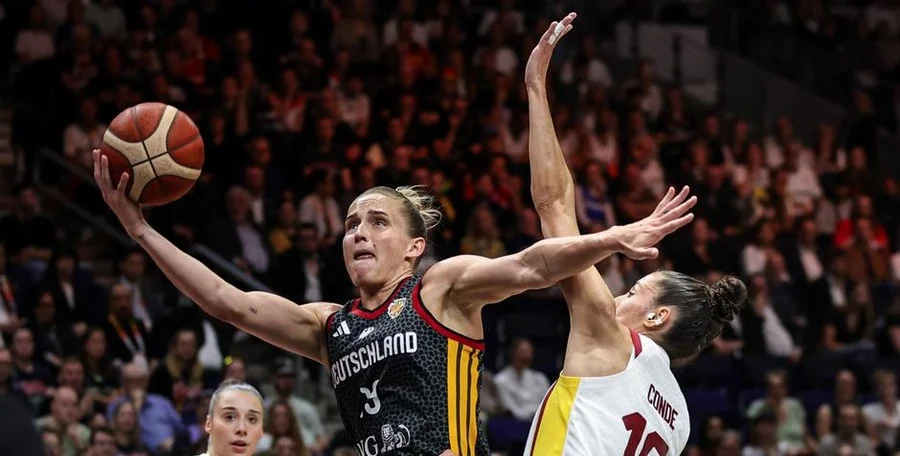
A wave of excitement has swept over German women’s basketball following the national team’s captivating performance at the recent World Cup in Berlin. The tournament, which concluded on September 13, saw Germany deliver a series of thrilling games. Led by stars Leonie Fiebich and Nyara Sabally, the team consistently improved through the preliminary and intermediate rounds.
Remarkably, Germany defeated reigning European champions Belgium in the quarterfinals. This victory marked what many considered their best-ever performance on the international stage. However, the final weekend proved challenging.
Germany subsequently lost to France in the semifinals. They then fell to Spain in the bronze medal match. Despite these defeats, the team viewed their overall tournament experience as a resounding success.
“We simply aren’t good enough yet,” Fiebich admitted after the loss to Spain. “We played with immense euphoria and even beat the European champions, Belgium. Still, maintaining that overperformance is tough. We will definitely get better.”
This World Cup performance represented a significant milestone for the program. The team previously qualified for the Olympic Games for the first time in 2024, where they also secured a surprising gold in 3×3 basketball. Furthermore, they finished fifth at the 2025 EuroBasket, positioning them as potential medal contenders for next year’s tournament.
Fan support during the World Cup was extraordinary. Approximately 230,000 tickets were sold, with most attendees being German supporters. Head coach Olaf Lange emphasized the importance of this moment. “We need to harness the pain the players are feeling right now,” he stated, explaining this emotional drive acts as a crucial ‘fuel for improvement’ in their individual development.
Despite this impressive national success, the domestic top-tier, the DBBL, presents a stark contrast for German women’s basketball. The league significantly lags behind international standards. Most national team players, including Fiebich, Nyara Sabally, her sister Satou (who missed the World Cup due to injury), Luisa Geiselsöder, and Frieda Bühner, play in the WNBA. Other key players compete in Spain, Taiwan, Australia, or US college basketball.
Only three members of the World Cup squad—Alexandra Wilke, Emma Eichmeyer, and Britta Daub—currently play for DBBL clubs. Wilke, for example, works as a secondary school teacher, highlighting the league’s semi-professional nature. Coach Lange, who previously coached in the DBBL from 1995 to 2002, lamented its decline. “Back then, the top clubs had better structures than they do today,” he noted. “Things are really going backwards.”
Lange expressed concern that he must encourage top players to seek opportunities abroad. “As long as nothing changes in the league, it will be difficult to sustain this success,” he warned. Ireti Amojo, a former Germany player and the new DBBL president since March, is working to professionalize the league. Her plans include hiring full-time youth development coaches and increasing arena capacities, some of which currently hold a mere 600 spectators.
However, the infrastructure challenges extend beyond the top division. Even if the World Cup sparked a massive influx of young girls into basketball, many clubs lack the resources to accommodate them. There is a significant shortage of coaches and available court facilities. “We should have started five years ago,” Amojo told Magenta Sport after the final. “We are too late to truly capitalize on this momentum.”
Amojo believes Germany lacks the necessary structures to provide aspiring players with optimal training conditions. This prevents them from developing into future stars like Leonie Fiebich or Nyara Sabally. Nevertheless, the tournament served as vital proof. It showcased significant public interest in German women’s basketball, defying previous skepticism.
“It was the kind of proof we all needed,” Amojo affirmed. “We already have a few levers we want to use to work on the structures. This certainly shouldn’t be the end of things.” The World Cup may just be the essential spark for much-needed future development.


